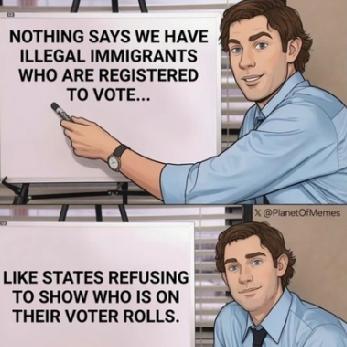
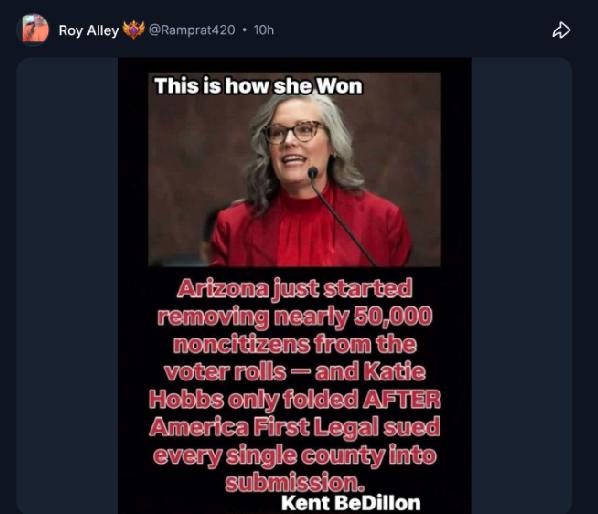
Stor sejr for at valgsvindel ikke længere tillades i Arizona !
Det vil hindre det demokratiske parti i at sende valgsedler til andre end amerikanske borgere 🙂
Der ER en grund til at det demokratiske parti HADER voter ID og korrekte verificerede voter rolls ( overt over stemmeberettigede) !!
Tages herfra
The full Ninth Circuit Court of Appeals on Friday vacated a lower court’s preliminary injunction and cleared the way for Arizona to enforce two key 2022 election integrity provisions that left-wing activist groups had blocked for years.
The en banc ruling in Arizona Alliance for Retired Americans v. Mayes hands a decisive defeat to the Arizona Alliance for Retired Americans, Voto Latino, and Priorities USA, the usual cast of Democrat-aligned voter registration outfits that sued to stop common-sense reforms aimed at preventing double voting and out-of-state voting schemes.
These groups claimed Arizona’s “Cancellation Provision” and “Felony Provision” somehow interfered with their “core” activities of registering and mobilizing voters. The full court wasn’t buying it.
Arizona’s Senate Bill 1260, passed in 2022, strengthened the state’s ability to keep voter rolls accurate:
- The Cancellation Provision requires a county recorder to cancel a voter’s registration in that county once the recorder receives confirmation (or confirms credible information) that the person has registered to vote in another Arizona county. This is basic list maintenance to stop people from remaining registered — and potentially voting — in multiple counties.
- The Felony Provision makes it a crime to knowingly provide a “mechanism for voting” to someone who is registered to vote in another state. The statute gives the example of forwarding an early ballot.
Left-wing groups sued, claiming these measures would force them to divert resources and chill their registration drives. A district court judge obliged them with a preliminary injunction. A three-judge panel later vacated that injunction, but the full court took the case en banc.
The majority opinion, written by Judge Anthony D. Johnstone, delivers a clear message rooted in the Supreme Court’s 2024 decision in FDA v. Alliance for Hippocratic Medicine: organizations cannot manufacture Article III standing simply by spending money to oppose a law they dislike or by claiming their “mission” is frustrated.
Under Hippocratic Medicine, an organizational plaintiff must show the challenged law “directly affect[s] and interfere[s] with [its] core business activities.” Mere diversion of resources to educate people about a law or to advocate against it is not enough.
The court held that the plaintiffs failed to clearly show any such injury from the Cancellation Provision. Their claim that new registrations might somehow get canceled instead of old ones was “highly speculative” and contradicted by Arizona’s longstanding procedures and Elections Procedures Manual. Spending money to warn people about a law that does not actually harm their registration work does not create standing.
The en banc court explicitly overruled a string of prior Ninth Circuit cases that had rubber-stamped organizational standing based on the old, expansive “frustration of mission + diversion of resources” test. Those precedents, including cases like East Bay Sanctuary Covenant, National Council of La Raza, and others, are no longer good law after Hippocratic Medicine.
Judge Daniel Bress, joined by Judges Callahan, Bennett, R. Nelson, and VanDyke, concurred in the result on the Cancellation Provision but criticized the majority for not going far enough in fully embracing the Supreme Court’s reasoning.
Judge VanDyke filed a separate concurrence calling for a modest adjustment to how the circuit treats intervening Supreme Court precedent.
The organizations did clear the low bar for pre-enforcement standing on the Felony Provision because the phrase “mechanism for voting” could arguably be read broadly enough to chill their activities and create a credible threat. But the court held they are unlikely to succeed on the merits.
Reading the full text and context of the statute, which targets illegal voting, not registration drives, the court concluded that “mechanism for voting” most naturally means instruments used to cast a vote, such as a ballot and ballot affidavit envelope. It does not criminalize helping people register to vote or educating them about the process.
Arizona can now move forward with enforcing these provisions. County recorders can clean up duplicate registrations when voters move within the state. And knowingly facilitating voting by people registered elsewhere remains a felony.
You can read the full ruling here.
Tages herfra
Leave a Reply