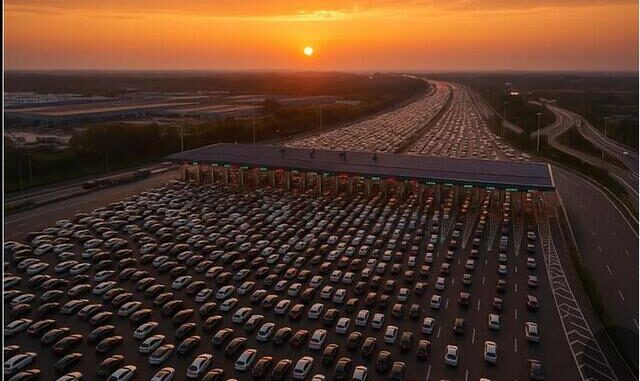
“36 Lanes to Nowhere: Inside China’s Massive Holiday Traffic Jam”
Taget herfra
Golden Week turns a highway into a parking lot
A drone pans across the Wuzhuang Toll Station in Anhui and all you see is red—thousands of taillights spread across 36 lanes that compress into four. Holiday drivers are pouring out of China’s National Day/Mid-Autumn “Golden Week” and into a forced merge that defeats momentum. Local reports pegged well over 120,000 vehicles passing the plaza on the final day. Nationwide, Golden Week tallied ~888 million domestic trips and about ¥809 billion (~$114B) in spending, a surge strong enough to overwhelm even the country’s biggest toll station. The pictures feel unreal; the geometry explains everything.
Why Wuzhuang Clogged
Plazas are fast only when flow remains balanced. Wuzhuang fans traffic into dozens of lanes so cars can clear scanners quickly, then forces them to zipper back together almost immediately. Open every booth and it still slows: the 36-into-4 squeeze creates chronic turbulence at peak volume. That’s exactly what you get when millions return home on the same day.
The scale, in context
Video Source: news.com.au
This isn’t the longest jam China has seen; that title belongs to the 2010 Beijing–Tibet corridor mess that stretched roughly 100 km over 12 days. Wuzhuang is different: shorter but wider—a single plaza swallowing a small city’s worth of cars in hours. It also sits inside the world’s largest high-speed road network: by the end of 2023, China counted ~184,000 km of expressways, more than any other country. Big roads solve most days. Surge days expose the choke points.
What it Means for Drivers (and Carmakers)
- Thermal and comfort tests: Hours of stop-and-go punish cooling systems, cabins, and batteries. Vehicles with smart idle strategies, efficient HVAC, and well-tuned shift maps win days like this.
- Driver-assist that matters: Adaptive cruise, lane-centering, and traffic-jam assist ease fatigue when average speeds crash into the single digits.
- Planning beats horsepower: Apps, staggered departures, and freight time-windows reduce the crush more than extra booths ever will.
…
Quick Comparison for US Readers
- Plaza scale: Wuzhuang’s 36 lanes dwarf typical US toll plazas, which usually feed more evenly into through lanes.
- Network length: The US Interstate spans ~49,000 miles; China’s expressways total ~114,000 miles and keep expanding. Most days, traffic flies. On national return day, physics calls the shots.
Bottom Line
Call it a masterclass in bottlenecks. The viral China traffic jam at Wuzhuang wasn’t a glitch in technology or a mystery in human behavior. It was a simple formula—too many cars + one brutal merge—played out on a supersized stage after one of the busiest travel weeks on earth. It just goes to show you the solution to congestion is almost never more lanes; people just fill them.
Taget herfra
Tænk hvis du er i yderste bane til venstre og du SNART skal dreje til højre !
Leave a Reply