Her er to artikler om hvad der engang var Church of England, men i dag blot hardcore kommunisme, der intet har med kristendom at gøre 🙁
The continued decline of the morally bankrupt Church of England
“Having incorporated almost every other leftist shibboleth, it’s now embracing conspiratorial antisemitism of the worst and most genocidal kind.”
Taget herfra
efore the 21st century, the UK, while not philosemitic, was also not actively antisemitic. The British establishment types wouldn’t want their daughter to marry a Jew, but the murderous hostility to Jews that characterized so much of Europe was absent in the UK. That reflected the British Protestant belief that British history and faith were inextricably intertwined with the land of Israel.
However, with the UK’s Islamic-leftist turn, Britain is now a virulently antisemitic country, something reflected in the Church of England (“CofE”). Not that this is a surprise. The CofE long ago became a completely bankrupt institution, parting ways with the Bible and British history. It’s the Gospel according to the BCC. No wonder that it’s accepted the antisemitic trope that Israel is a genocidal nation that has no right to exist.
Here’s a really quick chronology of Jews in Britain:
Archeology indicates that the British Isles were trading with Bible-era Israel beginning in the Bronze Age.
The British long believed that Joseph of Arimathea, one of Jesus’s disciples, came to Glastonbury right after the Crucifixion, when Jesus’s followers were still firmly Jewish.
The first Jews to settle permanently in the British Isles arrived shortly after the Norman Conquest, at the behest of William the Conqueror. In the ensuing years, Britain reflected a trend seen in the rest of Europe: Monarchs borrowed from the Jews, protecting them when they needed money and then, when they couldn’t pay their debts, leading pogroms or banishing them. (See, the York Massacre.)
In 1290, Edward I banished all Jews from the Kingdom. What this meant was that the British were not exposed to Jews at all, eventually knowing them only through Shakespeare’s Shylock.
In 1655, Oliver Cromwell allowed Jews to return to England, based in significant part on his understanding of the connection between the Old Testament and the New, and the fact that the God he worshipped originated with the Jews.
After the British monarchy was returned to the throne, Jews had a similar legal status to other dissenting faiths (no entrance to academia, no government jobs, etc.), although they were always seen as the “other” and viewed with some distaste.
As rights for Christian religious dissenters expanded in England, so, too, did rights for Jews. By the 20th century, Jews had full civil rights, but if you read the mid-20th century women writers I like so much—e.g., Agatha Christie, Georgette Heyer, Dorothy L. Sayers, D.E. Stevenson—the “othering” remained. However, as I’ve always said, you don’t have to like me; you just don’t get to kill me.
In 1917, when it was clear that Britain would take over part of the collapsed Ottoman Empire, the British government issued the Balfour Declaration, acknowledging that Jews should be able to create a Jewish national state in the former Ottoman colony of Palestine. The lure of Arab oil after WWII caused the British to break this pledge.
Through it all, the CofE avoided the virulent antisemitism that other faiths (most notably Islam, of course) embraced.
But recently, Britain has changed. It’s graduated from soft socialism to hardcore communism, and it’s welcomed so many fanatical Muslims into its midst that the nation is no longer a tolerant, liberal nation. Instead, it’s a nasty, anti-Christian, antisemitic place. And in a way, there’s no nastier, more anti-Christian institution than the CofE.
Over the years, the CofE has:
- Ordained women as priests (which is unbiblical).
- Ended all limitations on women serving in the church hierarchy. The current Archbishop of Canterbury (the head of the CofE) is Sarah Mullally, who sort of supports same-sex relationships (unbiblical), is sort of pro-choice (un-traditional-Christian), and is very pro-refugee (anti-British). (Amazingly, she is opposed to assisted suicide.)
- Approved of homosexuality as an acceptable behavior among the faithful.
- Authorized the church to bless homosexual unions.
- Allowed openly gay priests into the clergy.
- Became very supportive of so-called transgenderism.
- Went (and still goes) the extra mile for ecumenical relationships with Islam.
Given that the Church has allowed itself to be led by popular culture, rather than standing as a bulwark of firmly held Christian beliefs, it’s probably no surprise that only 10% of British people identify as members of the CofE, with only 1% attending church every week. Once it became the Church of the BBC, it ceased to have spiritual value.
But the CofE’s gospel according to the BBC continues. Most recently, it decided to take very seriously a poisonously antisemitic document, written in hardcore leftist babblespeak, accusing Israel of genocide (a claim belied by all available facts). Melanie Phillips explains that the document recycles “[e]very lie that’s been thrown at Israel over its war of self-defence in Gaza,” and does so using the standard tropes that describe Israel, not even as a country, but as a “colonial, settler, and exclusionary entity…”
Yet this is what the CofE, led by Mulally, treats as a serious document that, per Mulally, “reflects the pain and trauma of the Palestinian people.” There is no corollary sympathy for the pain and trauma of the Israeli people, who have been subject to decades of persecution that most recently culminated on October 7, 2023. Andrew Klavan calls antisemitism “the Devil’s flagpole,” for it is a sure sign that other evil is at play.
One of the key things a faith should stand for is values. And the CofE’s values are debased. They’re no longer tied to the Bible, both Old and New Testaments. It’s become the Church of Marx, which has alienated the British people, and now courts people—leftists and Muslims—who lust after its destruction.
Taget herfra
Og
The unfathomable darkness of the Church of England
af Melanie Phillips
Taget herfra
The Church of England is accelerating its descent into a terrible moral and spiritual darkness.
Yesterday, the Synod decided to “hear,” or engage with, a spittle-flecked document that demonises the State of Israel with vicious falsehoods and distortions, tries to to rob Jewish people of their historic identity and seeks to destroy Judaism itself as the religion rooted in the land of Israel.
Its very title, A Moment of Truth: Faith in a Time of Genocide, perpetrates the wicked lie that Israel is the perpetrator of genocide rather than the target and victim of genocidal attacks perpetrated by the people that this document, and the Church of England, go out of their way to sanitise, excuse and justify.
The document brands Israel a “colonial, settler, and exclusionary entity” (note the term “entity” — the language of genocidal Islamists — rather than “state”, “nation” or country”).
It describes the Palestinian Arabs falsely as the “indigenous people of this land” (it’s the Jews who are the actual indigenous people of the land).
It claims that “the genocidal war on Gaza is the continuation of the Zionist project to seize all of Palestine, emptied of its Palestinian people” (a demonstrable lie that demonises Zionism — and therefore Judaism, whose connection with the land of Israel is existential). And it demands a boycott of dialogue with “Zionists” — which in practice means boycotting as pariahs the majority of Jews.
Every lie that’s been thrown at Israel over its war of self-defence in Gaza — starvation, ethnic cleansing, war crimes — is thrown at it here. While it includes the weaselly caveat that it doesn’t justify civilian killings, it portrays opposition to Israel’s existence and “resistance” — aka the killing of Jews — as an act of religious faith.
It asserts that the Hamas atrocities in Israel on October 7 2023 were “born out of decades of injustice, oppression and displacement since the Nakba of 1948” (the war of extermination waged by the Arabs to destroy Israel at its rebirth in the Jews’ ancestral homeland, but which today’s would-be exterminators falsely describe as a Jewish war of colonial aggression).
Alluding to Israel’s war of self-defence in Gaza, it continues:
The claim of “self-defence” cannot stand. How can a coloniser defend itself against those it has colonised and expelled from their land?
Explicitly justifying Palestinian Arab murderous violence against Jews, it states:
At a time when Palestinian resistance and global solidarity movements are criminalised, we reaffirm the right of all colonised peoples to resist their colonisers.
It casts Zionists — not just Jews, but also Christian Zionists — as utterly diabolical, hell-bent on violence and killing for their own sake. This echoes the blood libels by medieval Christians that incited the mass slaughter of Jews in Europe over many centuries. Yet this document presents accusations of antisemitism primarily as a tool of political manipulation.
Not only does it accuse Israel of genocide in Gaza, the demonstrably ludicrous charge that’s become a hallmark of the west’s current anti-Israel insanity. More sickeningly still, it claims that the very creation of the Jewish state was a genocidal act. It states:
Genocide is a cumulative process – one that began in the minds of the settler-colonial powers of Europe when they denied the image of God in others and legitimised death, domination and slavery. We consider the State of Israel, established in 1948, to be built on racism and the ideology of ethnic or religious superiority.
This document is monstrous. It stands comparison with some of the most vicious and deranged expressions of Jew-hatred that have been produced over the centuries. Just to to give it serious consideration is itself an act of moral bankruptcy.
Yet the Archbishop of Canterbury, Dame Sarah Mullally, told Synod yesterday:
This document reflects the pain and trauma of the Palestinian people.
What does that reflect about Dame Sarah Mullally? The document is a malevolent, mendacious and unhinged attack on Israel, on Zionism and thus on Judaism, casting Israel and Zionism as demonic forces and regurgitating some of the most infamous tropes of ancient Christian Jew-hatred.
Does Mullally know nothing about this terrible history of the church? Is she really so ignorant of the Middle East that she doesn’t understand the first thing about the never-ending Palestinian Arab war to exterminate Israel and its strategy of demonising Zionism and the Jewish state?
Incredibly, it would appear that the leader of the Anglican church is indeed so utterly clueless that she has made both herself and her church into the handmaidens of evil. On her recent five-day visit to the Holy Land, Mulally chose to be pictured with Palestinian Arabs who are allegedly linked to terrorist organisations.
In a sermon in a church in the Palestinian Arab town of Birzeit, she spoke about the “freedoms” many locals “do not enjoy”. Jesus, she preached, had also spoken “to a community living in fear: his own people living in an occupied land and under foreign rule”. Thus Mullally slyly equated the Romans — who had persecuted the Jews of Judea of whom Jesus was but one — with today’s Israelis defending themselves against genocidal Palestinian Arab terrorism.
In an open letter written with Hosam Naoum, the Anglican Archbishop of Jerusalem, Mullally spoke of the “immense hardships” and “web of checkpoints” Palestinians faced in the “West Bank,” Gaza and East Jerusalem. The letter said:
In the West Bank, unchecked settler violence, forced displacement, systemic discrimination and expanding checkpoints have left the Palestinian population impoverished, desperate and powerless to enact change.
Powerless? But all the Palestinian Arabs need do to transform their lives for the better is give up the violence against Israeli Jews that they perpetrate every single day in order to further their century-old aim of destroying the Jewish homeland. The only reason for those checkpoints, which Mulally signally failed to note, is to pre-empt even more murderous Palestinian Arab violence against Israeli citizens.
The letter also called for an end to the “occupation” and a “viable two-state solution”, saying the archbishops feared for “the long-term future of the indigenous Christian Palestinian presence in the Holy Land that stretches back to the time when our Lord walked this land”.
What?? Jesus was a Jew who lived in Judea. There were no Christians at that time. There were no “Palestinians”. The claim that there was an “indigenous Christian Palestinian presence in the Holy Land” at the time of Jesus is a breathtaking lie.
Remarkably, in a previous pastoral letter written in 2024 by Archbishop Naoum with Mullally’s predecessor as Archbishop of Canterbury, Justin Welby, the two men made exactly the same claim that they feared for “the long-term future of the indigenous Christian Palestinian presence in the Holy Land that stretches back to the time when our Lord walked this land”.
The identical wording is a giveaway. The lie that Palestinian Christians were indigenous to the land, and that Jesus was one of them, is a propaganda line that has been pushed by Palestinian Arab Christians for decades.
The Church of England has itself been pushing this lie for years. Hence the same boilerplate wording. Lambeth Palace just cut and paste. The only thing that’s changed is the identity of the Archbishop of Canterbury.
The point is that Mullally’s nonsensical statements have to be viewed in a sinister context that’s almost entirely passed under the radar in Britain.
This is that for decades the church has fully embraced the exterminatory Palestinian Arab narrative against Israel and Zionism. Far worse, this narrative has kick-started the ancient Christian heresy of “replacement theology” or “supersessionism”, the murderous doctrine that lay behind the church’s persecution of the Jews in the Middle Ages.
That doctrine went underground after the Holocaust but has now appallingly been revived through being fused with the Palestinian cause.
Some principled Anglicans are horrified by all this. A few have been speaking out against the document. Dr Ian Paul, Associate Minister at St Nic’s, Nottingham, bravely spoke out at Synod and in this article here; another former Archbishop of Canterbury, Lord Carey, also spoke against it; and Giles Fraser, vicar of Kew in London (who has an Israeli wife and two Jewish children), wrote here that the Synod debate was a “disgrace” and that the document was “by any reasonable reading a clear and blatant piece of antisemitism, voted on by the Bishops thus: 25 yes, 0 no, 5 abstentions”.
I wrote about this whole issue in 2014 in an article in Commentary magazine. Although the article is extremely long, I am reproducing it below because it remains no less relevant today; and it’s so important that people understand the enormity of what has happened to the Church of England and its significance for wider society.
In post-religious Britain, people assume that the church is irrelevant. It is not. Even among those who are resolutely secular, the assumption remains that priests of the church are a moral lodestar representing integrity, truth and conscience. So when they speak about Israel, people believe them. This has had a devastating effect, because for decades the church has been promulgating incendiary calumnies against Israel with a theological underpinning that casts the Jews as the party of the devil. Its importance in helping create today’s insane levels of Jew-hatred should not be underestimated.
Shockingly, the church has allied itself with evil. To understand how this could have happened, please read my article below.
*****
‘Jesus Was a Palestinian’: The Return of Christian Antisemitism
Protestants increasingly believe a potted and antisemitic Palestinian narrative of Middle Eastern history
Melanie Phillips, Commentary, June 2014
Manger Square was bedecked with huge photomontages of classic artworks featuring Christian imagery superimposed with images from the Palestinians’ modern reality. Caravaggio’s “Ecce Homo” merged with a photograph of Palestinians crossing an Israeli checkpoint on their way to Jerusalem, equating Palestinians with Jesus and his suffering.
—The New York Times, May 25, 2014, reporting on Pope Francis’s visit to the West Bank
Within the Protestant world, many churches are deeply hostile to the State of Israel. They present the Palestinians as victims of Israeli oppression while ignoring the murderous victimization of Israeli citizens at their hands. This much is generally known. What is less known is the even more disturbing fact that this perverse animus is increasingly fed not by the politics of the present moment but by theology.
This is all the more striking because millions of evangelical Christians are among the most passionate supporters of Israel in America and elsewhere. These Christian Zionists believe the Hebrew Bible’s account of how God chose the Jewish people to form a kingdom of priests and promised them the land of Israel. That religious belief has turned Christian Zionists themselves into a key target for evangelization on the part of those churches that have Israel in their crosshairs—and those evangels are bearing fruit.
The Christian world likes to forget it, but the history of its relationship with the Jews is terrible. In medieval Europe, the Catholic Church used blood libels to incite the population against the Jews, converted them at knifepoint, and murdered them in great number.
These pogroms were driven by a particular demonology called replacement theology, also known as supersessionism. Going back to the early Christian father Origen (182–254 C.E.), this idea holds that, because the Jews denied the divinity of Jesus, all the promises God had made to them now belong to Christians. Exiled from God’s love, the Jews had become the party of the Devil.
After Auschwitz, this vicious theology unsurprisingly disappeared from view. But it turns out that it only went underground. For now it has returned with a fresh geopolitical impetus furnished by “Palestinian liberation theology,” itself a fusion of Palestinian political aspirations and Christian thinking.
It is a variant of liberation theology, the doctrine propounded in the 1960s to suggest that socialist revolution was the proper fulfillment of the Christian duty to the poor. In this iteration, Jesus becomes a Palestinian persecuted by the Jews while Jesus’s descendants—who knew he had any?—become today’s Palestinians, crucified in the very land that was promised to them. Their liberation would, of course, require the dissolution of the Jewish state.
These malevolent concepts, spreading from Palestinian Christians to churches in the West, are rooted in an audacious strategy adopted by the Palestinian Authority to deny Israel’s right to exist by changing Jewish history to suit its own end. Part of this strategy involves denying that Jesus was a Jew from Judea and turning him into a Palestinian who preached Islam.
Clearly, this is a tall order: Rome didn’t change the name of Judea to Palestine until 136 C.E., and Islam first surfaced in the seventh century C.E. Nevertheless, the Palestinian leadership repeatedly claims that Jesus was a Palestinian.
In his Christmas message last year, the Palestinian Authority president, Mahmoud Abbas, described Jesus as a “Palestinian messenger.” In the same month, the PA’s chief negotiator, Saeb Erekat, who had described Jesus as “Palestine’s first martyr,” said that Jesus was “the first Palestinian after the Canaanite Palestinians.”
A Fatah adviser who publishes under the name Adel Abd al-Rahman wrote:
Jesus, may he rest in peace, is a Canaanite Palestinian. His resurrection, three days after being crucified and killed by the Jews…reflects the Palestinian narrative, which struggles against the descendants of modern Zionist Judaism, in its new colonialist form, that conspires with the Western capitalists who claim to belong to Christianity.
While Jesus is represented as a Palestinian Arab, the Jewish people of today are apparently not Jews at all. As Mitri Raheb, a Lutheran pastor in Bethlehem, said in 2010:
I’m sure if we were to do a DNA test between David, who was a Bethlehemite, and Jesus, born in Bethlehem, and Mitri, born just across the street from where Jesus was born, I’m sure the DNA will show that there is a trace. While, if you put King David, Jesus, and Netanyahu [together], you will get nothing, because Netanyahu comes from an East European tribe [the Khazars] who converted to Judaism in the Middle Ages.
Accordingly, the true inheritors of Israel are not the Jews but the Arabs. As the former Anglican bishop of Jerusalem, Riah Abu el-Assal, claimed of Palestinian Christians:
We are the true Israel…No one can deny me the right to inherit the promises, and after all the promises were first given to Abraham and Abraham is never spoken of in the Bible as a Jew…He is the father of the faithful.
Such fantastic claims come from interpreting the Bible as a Palestinian supersessionist manifesto. The crucible of these claims is the Sabeel Ecumenical Liberation Theology Center, located in East Jerusalem and founded in the early 1990s by Father Naim Ateek. A major resource used by Anglican clergy, aid agencies, and companies that bring Christian pilgrims to tour the Holy Land, this center produces systematic, theologically based lies and libels about Israel.
Ateek, who is a close friend of many senior Anglican bishops, has redirected at Israel the ancient charge of deicide. In December 2000, he wrote that Palestinian Christmas celebrations were “marred by the destructive powers of the modern-day ‘Herods’ in the Israeli government.” In his 2001 Easter message, he wrote: “The Israeli government crucifixion system is operating daily. Palestine has become the place of the skull.” In a sermon in February of the same year, he likened the Israeli occupation to the boulder sealing Christ’s tomb.
With these three images, Ateek has figuratively blamed Israel for trying to kill the infant Jesus, crucifying him, and attempting to prevent his resurrection. Ateek’s book Justice and Only Justice inverts history, defames the Jews, and sanitizes Arab violence. Modern anti-Semitism is addressed in one paragraph; Zionism is portrayed as an aggressive colonial adventure. Courageous Jews are those who confess to “moral suicide” and believe Judaism should survive
without a state.
In a similar vein, Jewish statelessness has been turned into a theological imperative by those using the Bible to delegitimize Israel. In 1967, a group of Arab Christians issued a memorandum entitled “What is Required of the Christian Faith Concerning the Palestine Problem.” As the Christian analyst Dexter Van Zile has observed, this document suggested that Jewish statelessness was a necessary precursor to the salvation of humanity. Stating that “the vocation of the Jewish people is universal not particularist,” the document goes on: “It is clear from this that the creation of an exclusively Jewish state of Israel goes directly against God’s plan for the Jewish people and the World.” The end of the Jewish people as a political entity was a sign of the first coming of the Son of Man and the advent of the Kingdom of God.
In 2009, a group of Palestinian Arab Christians published the Kairos Document—a manifesto named for a Christian resistance statement published in South Africa in 1985, with the clear purpose of likening Israel to the apartheid regime. While purporting to be a momentous solution to the Middle East impasse, the Kairos Document simultaneously claimed that Jewish sovereignty was an affront to God’s plan for humanity, this time based on secular notions of human rights.
Increasingly, such claims are making inroads into Western churches, whose hostility toward Israel has long been fueled by their relationship with churches in Arab countries. This hostility has been heavily influenced by the World Council of Churches (WCC), which was founded in 1948, within months of Israel’s own founding. The Middle Eastern churches that belonged to the WCC had learned to adapt their message over the years to placate the Islamic rulers of the Arab countries where they were situated. As a result, the WCC hardly ever mentions the persecution of Christians around the world. Instead, it displays an institutionalized obsession with demonizing Israel. A WCC insider told Paul Merkley, professor emeritus of history at Carleton University, Ottawa, and a noted authority on Christian attitudes to Israel, that in general “the critique of some Israeli sin would be severe, while Arab countries were spared any kind of condemnation in order not to jeopardize Christian missionary interests there.”
The WCC played a key role in bringing about the UN Conference on Racism, Racial Discrimination, Xenophobia, and Related Intolerance—the anti-Israel, anti-Jewish meeting convened in Durban, South Africa, a few days before 9/11. WCC representatives demanded that the UN denounce Israel for “systematic perpetration of racist crimes including war crimes, acts of genocide, and ethnic cleansing.” Merkley observes:
This Durban Declaration was achieved in large part by the active lobbying of the World Council of Churches serving as brokers between the Muslim states and Western opinion in August 2001. Today, the Durban Declaration serves as the source of the mottoes with which respectable people in our part of the world shape their campaigns to deprive Israel of her right-to-life. WCC statements on this theme are parroted by the official journals and newsletters of the major Protestant denominations in the United States and elsewhere around the world.
The WCC is particularly influential over progressive Western churches, which subscribe to its advocacy for the world’s poor and dispossessed and which have therefore also absorbed its narrative about Israel. As Van Zile has observed, for many years now a group of five American Protestant churches—the Presbyterian Church (U.S.A.), the United Church of Christ, the United Methodist Church, the Episcopal Church, and the Evangelical Lutheran Church in America—have legitimized the increasingly virulent anti-Israel movement in the United States. The general narrative presented by these churches is that Israel could unilaterally bring an end to the Arab–Israeli conflict but chooses not to because of flaws in its national character.
Some of their adherents have protested their attacks on Israel. At the Episcopal Church’s General Convention in June 2006, three bishops tabled a resolution calling on the church to apologize for its “consistently unbalanced approach to the conflict in the Middle East.” An explanation accompanying the resolution stated that “virtually all General Convention resolutions concerning the Middle East—and all public policy statements by Episcopal agencies—have relentlessly criticized the State of Israel, portraying the Jewish state as an oppressor nation and the Palestinian people as victims of Israeli oppression.”
In July 2005, the General Synod of the United Church of Christ passed a “Tear Down the Wall” resolution that called on Israel to take down its security barrier but did not call upon the Palestinians to stop the terror attacks that prompted its construction.
That same year, the Churchwide Assembly of the Evangelical Lutheran Church in America passed a resolution affirming a “Peace Not Walls” campaign. While exhibiting less animus toward Israel than other Protestant churches, it still placed the onus for ending the Arab–Israeli conflict on Israel.
There have been repeated attempts to get these churches to withdraw their investments from companies connected to Israel. In 2005, the Virginia and New England conferences of the United Methodist Church passed resolutions calling for divestment. In 2004, a divestment resolution singling out Israel as a target was passed by the general assembly of the Presbyterian Church (U.S.A.). That resolution also claimed that Israel’s “occupation” had “proven to be at the root of evil acts committed against innocent people on both sides of the conflict.”
Although the Presbyterians subsequently rescinded their policy of singling out Israel as a target for divestment, in 2012 they voted for boycotting products manufactured in the West Bank.
This June, the PC(U.S.A.) biennial general assembly will feature yet another attempt to divest from Israel in the wake of a document called Zionism Unsettled, a “study guide” published earlier this year by the Israel-Palestine mission of the Church. It attacks “the theological and ethical exceptionalism of Jewish and Christian Zionism, which have been sheltered from open debate despite the intolerable human-rights abuses rooted in their core beliefs.” Zionism, it suggests, has destroyed both indigenous Palestinian lives and Jewish communities across the globe in a supremacist misinterpretation of God’s word on par with “Christian exceptionalist beliefs [that] contributed to the Nazi Holocaust, the genocide of Native Americans, and countless other instances of tragic brutality.”
As for the Church of England, Canon Andrew White, formerly the archbishop of Canterbury’s envoy to the Middle East and now the vicar of Baghdad, is a Christian Zionist. According to White, Palestinian-influenced replacement theology has now gone viral within the Church of England. The biblical God is viewed as the God of the oppressed; the Palestinians are the oppressed; and the Church must therefore fight for justice against their oppressor, the Jews, so the Palestinians can enter their promised land. This analysis, says White, in which politics and theology thus became inextricably intertwined, has influenced entire denominations, the majority of Christian-pilgrimage companies, and many of the major mission and aid organizations.
The British theologian Colin Chapman’s highly influential 2002 book, Whose Promised Land? sets out the theological delegitimization of Israel. Chapman wrote: “The coming of the kingdom of God through Jesus the messiah has transformed and reinterpreted all the promises and prophecies in the Old Testament.” Jews and Christians had become, in his phraseology, one “new man” made of both Jew and Christian, and so this new category of person therefore did not warrant a Jewish state.
“Christian Palestinianism” is spearheaded in the UK by Stephen Sizer, the vicar of Christ Church, Virginia Water, in Surrey. Sizer’s book Christian Zionism: Road-Map to Armageddon? has been endorsed by many leading British and American bishops and theologians. In it Sizer wrote:
To suggest therefore that the Jewish people continue to have a special relationship with God, apart from faith in Jesus or have exclusive rights to land, a city, and temple is, in the words of John Stott [a leading British evangelical], ‘biblically anathema.’
Church of England bishops and archbishops systematically present Israel as brutal oppressors and the Palestinians as their victims. In June 2005, a report by the Anglican Peace and Justice Network—which underpinned a short-lived divestiture move—compared Israel’s security barrier to “the barbed-wire fence of the Buchenwald camp.” In 2012, the General Synod of the Church of England voted overwhelmingly to strengthen ties with the Ecumenical Accompaniment Programme in Palestine and Israel (EAPPI), a group that supports the boycott, divestment, and sanctions campaign against Israel and brings people to the West Bank to experience what EAPPI calls “life under occupation.”
The chief Christmas-time decoration this year at St. James’s Church, Piccadilly, in the heart of central London, was in front of the building: a wall 24 feet tall and 100 feet long. This, the church informed the public, was a replica of the Israeli wall that surrounds Bethlehem.
But there is no wall that surrounds Bethlehem. Israel’s security barrier, much of which is a simple chain-link fence, takes the form of a wall merely along the area where the risk of terrorist infiltration into Jerusalem is very high. Indeed, the sole purpose of the security barrier is to prevent terrorist attacks on Israelis. The wall is credited with having significantly reduced attacks while attempts to perpetrate them remain persistent.
Yet this key consideration was all but obliterated by St. James’s Church, whose wall was the centerpiece of a two-week-long presentation about Israeli oppression of the Palestinians called Bethlehem Unwrapped. The progressive churches have turned Bethlehem, that iconic Christian town, into a symbol of Palestinian suffering at the hands of Israel.
This shows breathtaking disregard for the facts. Located a few minutes’ drive down the road from Jerusalem, Bethlehem was once predominantly Christian. In 1948, some 80 percent of its population was Christian; now, it is estimated at between 20 and 40 percent. According to Justus Weiner, a legal scholar at the Jerusalem Center for Public Affairs, the number of Christians in Bethlehem declined precipitously under Jordanian occupation from 1949 to 1967, when thousands of Muslims were settled in the town.
“Christian Arabs have been victims of frequent human-rights abuses by Muslims,” Weiner has written. “There are many examples of intimidation, beatings, land theft, firebombing of churches and other Christian institutions, denial of employment, economic boycotts, torture, kidnapping, forced marriage, sexual harassment, and extortion. Palestinian Authority (PA) officials are directly responsible for many of the human-rights violations. The situation of these Christians has become grim.”
Naim Khoury is the pastor of Bethlehem’s First Baptist Church. He and his family have been systematically harassed and attacked by Muslims. The church has been firebombed 14 times, and Khoury has been shot at several times in the last decade. Bethlehem’s Christians believe this hostility has worsened in recent years. “People are always telling them, ‘Convert to Islam. Convert to Islam,’” Khoury has said. “’It’s the true and right religion.’”
The one place in the Middle East where Christians are safe and are thriving is Israel. According to Merkley, the Christian population of Israel rose sixfold from about 34,000 in 1948 to nearly 180,000 in 1998. It is the only country in the Middle East where, over the last half century, the number of Christians has grown in absolute numbers and has remained stable as a proportion of the whole population. Everywhere else Christian populations are in decline, in many cases precipitously.
And yet, astoundingly, the churches blame Israel for this decline. Shortly before Christmas 2006, the then Archbishop of Canterbury, Rowan Williams, assigned responsibility for the flight of Palestinian Christians from Bethlehem to Israeli policies and the security barrier. He asked rhetorically:
I would like to know how much it matters to the Israeli government to have Christian communities in the Holy Land. Are they an embarrassment or are they part of a solution? That’s a question.
This scapegoating of Israel is all the more astonishing considering the persecution of Christians at the hands of Islam. According to Open Doors, a nondenominational Christian group, about 100 million Christians are currently being persecuted around the world in more than 65 countries. Of the top 10 countries on the list—North Korea, Saudi Arabia, Afghanistan, Iraq, Somalia, Maldives, Mali, Iran, Yemen, and Eritrea—eight are majority-Muslim states threatened by what Open Doors called Islamic extremism.
In Egypt, Coptic Christians have been attacked, murdered, and driven out. In Syria, whole towns have been emptied of their Christian populations. In December 2013, at least 1,000 Christians were killed in clashes with Muslims in the Central African Republic. “They are slaughtering us like chickens,” one Christian said. In the same year, seven Christian churches were torched by Muslims in Russia.
In February 2014, jihadists bombed churches in Zanzibar for being “dens of non-believers.” In March 2014, members of Somalia’s Al-Shabaab militia publicly beheaded a mother of two girls and her cousin after discovering they were Christians. The same month in Nigeria, more than 150 Christians were butchered in a massacre in Kaduna, one of innumerable attacks on Christians there. In Sudan, Christians have been hacked to death for refusing to convert to Islam or burned alive inside their churches. In Eritrea, more than 3,000 Christians are in jail. There are innumerable similar instances. Yet on all this carnage among their own flock, the churches are almost totally silent.
There are two main reasons that progressive Protestant churches have adopted an anti-Israel narrative. The first is the hemorrhaging of their base. Churches that were once in the forefront of social reform in both America and Britain have seen their influence dwindle along with their congregations. Championing the “poor and oppressed” Palestinians seems to offer a significant role in the national conversation.
The second reason is the eclipse of faith among the progressive clergy. Increasingly unwilling or unable to preach the literal truth of scripture, they have turned themselves into campaigners for the poor and oppressed. As a result, the sociological and theological positions struck by the WCC penetrated the Western churches and became their orthodoxy, too. This was the context that allowed both Palestinian and Western Christians to fuse the political and the theological and revive the murderous calumny of deicide against the Jews, with Jesus resurrected as the ultimate suffering Palestinian.
Now there is an even more alarming development. The latest Christians to succumb to this delegitimization of Israel and the return of replacement theology are among the evangelicals, the very bedrock of Christian Zionism. This is all the more devastating precisely because these Christians take scripture very seriously. Whereas the progressive churches have absorbed the Palestinian theological calumny against the Jews almost as an afterthought, some evangelicals are rewriting the theology that inspires their every action. They are not just anti-Zionists. They are religiously inspired, anti-Jewish supersessionists.
An early harbinger of this change was a meeting in London in 1986 hosted by John Stott. The Lausanne Congress of World Evangelization set up a group called Evangelicals for Middle East Understanding to oppose the view that Israel was the fulfillment of biblical prophecy. Such people subscribe to a movement that the Christian analyst Paul R. Wilkinson has termed “Christian Palestinianism.”
In his book Who are God’s People in the Middle East?, Gary Burge recounted how he converted from Christian Zionism after being told by Father George Makhlour of St. George’s Greek Orthodox Church in Ramallah: “The Church has inherited the promises of Israel. The Church is actually the new Israel.” Burge came to believe that “followers of Jesus were the new people of God. And they would inherit the history and the promises known throughout the Old Testament…Whatever the ‘land’ meant in the Old Testament, whatever the promise contained, this now belonged to Christians.”
In March this year, some 600 or so evangelical Christians attended a four-day event in Bethlehem called Christ at the Checkpoint. The subtext of this conference was a fusion of theologically based Christian Jew-hatred, Palestinian victimology, and a wholesale rewriting of history. One witness, Brian Schrauger, wrote: “Except for explicit calls to violence, every part, every aspect of rhetoric by Islamic Fatah and Hamas was brilliantly, horrifically ‘Christianized.’ In the aftermath of attendance, I find myself nauseous, shocked, and soiled in my soul.”
This was the third high-profile conference under the title of Christ at the Checkpoint (or CatC, as the organizers call it). These gatherings bring together evangelical Christians from around the world, according to its manifesto, to “reclaim the prophetic role in bringing peace, justice, and reconciliation in Palestine and Israel.”
What this actually means is that participants tell each other about the “brutal Israeli occupation” and “oppression” of the Palestinians, which they cast as a living reenactment of the suffering of Jesus at the hands of none other than the forerunners of those very same Israeli oppressors, the Jews. They then return home and spread the word among evangelical churches. Some dismayed observers have dubbed this the “evangelical intifada.”
For many Christians, both evangelical and progressive, this particular demonization of Israel is irresistible. Through the suffering Palestinians, they can live Jesus’s story in the modern world. They don’t need to believe in God. They merely need to see the Palestinians as suffering as Jesus suffered.
And of course the geography is crucial. Those promoting Palestinian liberation theology play on the fact that the “Holy Land” is the most important place in the world for Christians. As Van Zile says:
They bring Christians in to walk the Via Dolorosa; they feel they are walking in the path trodden by Jesus as a suffering Christian. The Palestinians fawn over them, but the Christians feel they are living the Gospel. They get off on Palestinian suffering and Jewish misdeeds. Even though Israel is the one country in the Middle East where Christians are increasing, they find Israel intolerable because the Jews are supposed to have been wiped off the moral map. So they have to turn them into Nazis.
For the young evangelicals lapping up the lies at the CatC conference, there is an additional dynamic. They hate being tarred with the same uncool brush as their parents’ generation. In their book UnChristian: What a New Generation Really Thinks About Christianity, David Kinnaman and Gabe Lyons conclude that young evangelicals, just like their secular peers, find conservative Christianity to be too anti-homosexual, too judgmental, and too political. Like John Lennon, they imagine a world with no barriers to peace and love. They don’t think of themselves as anti-Israel, because to be “anti-” is not very loving. They tell themselves they are instead pro-Palestinian, pro-peace, and pro-love.
According to Robert W. Nicholson, a young Christian who has written bravely about the turn among evangelicals:
Love now trumps all amongst the millennials at CatC. The young don’t want to be seen in the same hateful light as their parents. They say in relation to same-sex marriage, I just love everyone. So, at CatC Israel is represented as a killing machine. It’s such an easy jump to make. Jewish wrongdoing played a big role in the early Christian story—so if you give people a sense they are targets of Jewish wrongdoing, they feel like Jesus.
The young CatC participants are taken on field trips to the “segregation wall,” the checkpoints, and the Palestinian areas of East Jerusalem. They are not taken to Jewish neighborhoods. They do not meet Jewish victims of Palestinian terrorism. And they do not visit hospitals where Arabs and Jews are treated alongside each other by Arab and Jewish doctors.
The CatC conferences are run by the Bethlehem Bible College and Holy Land Trust (HLT). Sami Awad, founder and executive director of HLT, has said the trust has “done training in nonviolence for Hamas leaders and other militant groups” and that nonviolent demonstrations are “not a substitute for the armed struggle.”In an interview with Nicholson, Awad’s uncle Alex, pastor of the East Jerusalem Baptist Church, a professor at the Bethlehem Bible College, and a prime CatC organizer, said:
The message of Christianity is a universal one that is not interested in ethnicity or territory. The new covenant ushered in by the coming of the messiah made the old covenant obsolete…What happened in 1948 and 1967 was not moral, and I personally don’t believe it had any divine significance. Anyway, there doesn’t necessarily need to be a “state” of Israel for the re-gathering of the Jews to be fulfilled… I am not anti-Semitic whatsoever. God saved me from that long ago. The Jews are still special to God… But so are all people.
Sweeping Jews out of the land of Israel also means sweeping them out of their own history.
According to Nicholson, there were claims at this year’s CatC conference that the “first naqba” was in 587 B.C.E. when “Palestinians” were “exiled to Babylon,” and the “first intifada” was in 70 C.E. when Titus destroyed the Temple. But, of course, it was the Jews who were exiled from the land of Israel in those years. He says he also heard claims that the Jews of today were really all Khazars, and that it was morally and theologically wrong to say Israel was a Jewish state.
Nicholson was distressed by the reaction of the conference participants to these absurdities. “You look around and you see well-meaning Americans nodding along,” he said. “They don’t know what did happen in history, they don’t know what it means so they just go along with it.” When someone linked terrorism with either Yasir Arafat or Israel’s security barrier, people started booing.
What so deeply alarms close observers such as Nicholson and Van Zile is the insidious, mind-bending manipulation of this approach and the bizarre and poisonous beliefs that are being swallowed as a result. Prejudice against the Jews, a negation of Jewish suffering, and the demonization of Israel are carefully disguised by a mantra of peace’n’love. This, the idealistic, naive, and ignorant CatC participants are told, is what Christianity is all about.
Hand in hand with Christian Palestinianism has come the steady Islamization of the Church. Increasingly ignoring its Jewish roots, the Church has reached out instead to Islam. In a paper published in 2007, Margaret Brearley, a British scholar of interfaith relations and former adviser to the archbishop of Canterbury, wrote that Anglicanism as a whole seemed to be gradually uprooting itself from its Judaic heritage. It was no longer normative for Anglican clergy to know Hebrew, and, if clergy studied another religion at theological college, it was now more likely to be Islam than Judaism.
The Church, she wrote, had taken major steps to affirm Islam as a fellow “Abrahamic faith.” The most important of these initiatives was a Christian-Muslim seminar called Building Bridges, convened by the archbishop of Canterbury in January 2002. The proceedings of the inaugural meeting stressed “the shared journey of Christians and Muslims” and the “importance of deepening our dialogue and understanding,” especially following 9/11. Papers presented by some Muslim and Christian scholars suggested equivalence, even unity, between Islam and Christianity. Bishop Kenneth Cragg, for example, stated that the “Magnificat and Allahu akbar are the sure doxologies with which our two faiths begin” and that “in the mystery of our created human trust…two faiths are one,” while Professor David Kerr explained radical Islam “as a form of liberation theology.” Brearley wrote:
The rapprochement of Anglicanism and Islam has encouraged a process in which any critique of Islamic nationalism or Islamism is either extremely muted or completely absent.
The essential problem, says Canon Andrew White, is the lack of will in the church to face the difference between Judaism and Islam. “They don’t want to recognize that their faith comes from Judaism,” he said. “They talk instead of the ‘children of Abraham’ as if we are all in it together. The reality is, however, that although Islam and Judaism have a lot in common in terms of customs, they are as far apart as Christianity is from heathenism.”
As a result, the Church of England is conniving at an obnoxious historical revisionism. Muslims claim not only that they inhabited the land of Israel before the Jews but also that Islam was somehow the real Judaism before the Jews corrupted their own religion. The Koran says Islam came before Judaism and Christianity, and was the faith practiced by Abraham, who was a Muslim (3:67–68). It refers to Islam as the religion of Abraham many times (2:130, 135; 3:95; 4:125; 6:161). Islamic tradition teaches that it is Ishmael, not Isaac, whom God orders Abraham to sacrifice. It teaches that Jews and Christians corrupted their scriptures, so Allah sent a fresh revelation through Mohammed. This cancelled out Judaism and Christianity and brought people back to the one true religion of Islam that Abraham had practiced.
The existence of Israel as a Jewish state is thus anathema because Islam teaches that the Muslims are in fact the real, authentic Jews. As Osama bin Laden declared in his “Letter to the American People”:
It is the Muslims who are the inheritors of Moses (peace be upon him) and the inheritors of the real Torah that has not been changed. Muslims believe in all of the Prophets, including Abraham, Moses, Jesus, and Muhammad, peace and blessings of Allah be upon them all. If the followers of Moses have been promised a right to Palestine in the Torah, then the Muslims are the most worthy nation of this.
Christians would seem increasingly to agree.
The really difficult problem is that supersessionism is not some fringe theology but is deeply rooted in Christian thinking. At the most basic level, the Church believes that Christianity superseded Judaism. The Holocaust caused Western churches to rethink this, although those in Eastern countries remained unmoved. But whereas in the 1965 Papal encyclical Nostra Aetate, the Catholics tried openly to face up to and repudiate their own anti-Jewish thinking, the Protestant churches quietly brushed supersessionism under the carpet.
This failure to address the theological roots of Christian anti-Jewish prejudice left the Protestant churches open to the politically opportunistic and revisionist Palestinian application of the doctrine and its use as a weapon against the State of Israel.
In all the uproar over the boycott, divestment, and sanctions movement and the campaign to delegitimize Israel, the role of Protestant churches has received scant attention. This is a terrible mistake. The return of replacement theology is of the greatest possible significance to the way Israel is regarded in the West. The Church still has great influence over Western culture. Even in Britain, people think Christian clerics embody integrity, conscience, and truth-telling; when they assert that Israel is a racist, oppressive, aggressive state, they are believed. And in the United States, such is the centrality of Christianity and the Hebrew Bible that if this theological and political slide into untruth and hatred is not stopped, there will be drastic consequences—not just for support of Israel but for American society.
As Christians are murdered by Islamists across the world, some of their churches are directing their passions elsewhere. They are busily rewriting history, constructing a theology out of gross political distortion and lining up once again with historic forces of unfathomable darkness. It is not just the State of Israel that is being threatened as a result. Stamping upon its parent, the Church is embracing its own assassin—and the West’s potential nemesis.
Taget herfra
Denne her er fra 2013:
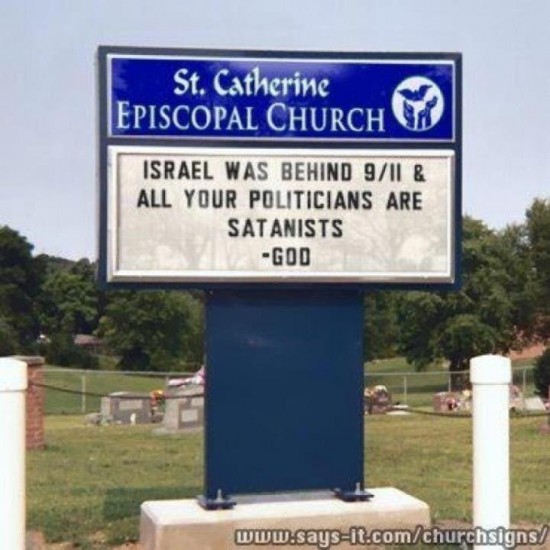
Den katolske kirke høster, hvor anglikanskanerne spilder. Man har i mange år budt velkommen til anglikanske præster og deres familier i den katolske kirke. Der er masser af ledige katolske sogne. Det siges, at den anglikanske kirke er katolsk uden pave.
Kirkernes mangement nu om dage kan synes lidt underlig Pakistansk flag vejede over Westminster Abbey,Nicab mode show Birmingham Cathedral,gniden sig op og ned af “Palestine”hvad det nu er for en stoerelse,naah ja dem der dansede og uddelte slik 7 October,totalt mum om grooming gangs, overgrebene,mordene paa deres “sogneboern” i Nigeria,Mali,Congo,Sudan Pakistan,Egypten how det var en smutter, de er jo Coptere