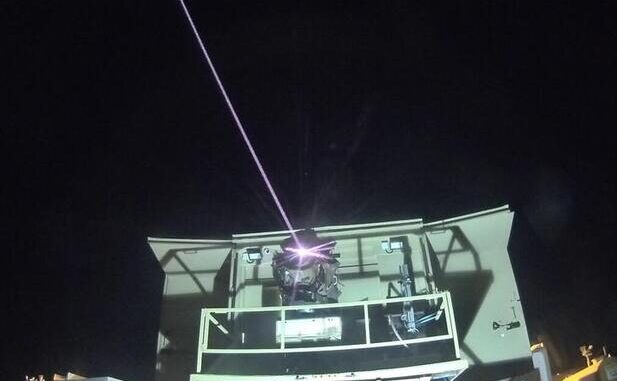
Stew Magnuson skriver her om systemet. Det nye er “The technological breakthrough was choosing to shoot hundreds of small, coin-sized beams at a target, rather than just one large beam, he said. The small beams do not get dispersed in the atmosphere; however, they are not powerful enough to destroy a target by themselves.” og “Iron Beam has been tested at “tens of kilometers” and will continue to improve its range”
Taget herfra
HAIFA, Israel — If all goes as planned later this year, the Israel Defense Forces will be the first military to widely deploy a high-energy laser weapon: the Iron Beam air defense system.
It could prove to be a watershed moment in the history of military technology.
Directed energy weapons have been the subject of speculation, research, development and testing for decades, with numerous technological dead ends and cancelled programs.
Smaller lasers weapons that can shoot down small drones close by a vehicle have been used or are close to a high technology readiness level. But so far, there have been no large orders forthcoming from the U.S. military or others.
Consequentially, as the report, “Directed Energy Weapon Supply Chains” published by the National Defense Industrial Association’s Emerging Technologies Institute in January 2024 pointed out, the United States has no established laser weapon industrial base to speak of — no supply chain, no factories, no cadre of workers. The U.S. military has fewer than 20 laser weapon systems, all of them built in laboratories, according to a list provided by the Pentagon’s Joint Directed Energy Transition Office.
In a briefing with reporters in early December at the headquarters of Rafael Advanced Defense Systems, company chairman Yuval Steinitz did little to mask his pride, calling the Iron Beam a scientific and technological breakthrough and emphasizing that Israel had accomplished what so many others could not.
The crux of the problem in the past was the atmosphere, he explained. Lasers do fine when they are small and are used for applications such as performing eye surgery, but once they are weaponized, the air density begins to disperse their energy, making them ineffective. The larger the beam, the more atmospheric interference.
“We had to find a way to bypass the atmosphere and keep the lasers as strong as when they were” fired, he said.
Israel has an immediate and pressing need for a directed energy weapon. It has been under attack since Oct. 7, 2023, and since then has used its Iron Dome system to ward off ballistic missile and drone attacks from Hezbollah in Lebanon, Houthi rebels in Yemen and Hamas in the Gaza Strip, as well as two major direct attacks from Iran.
The Iron Dome detects threats, then fires Tamir missiles to intercept and destroy missiles and drones before they reach their targets.
The Iron Beam will be integrated into the already proven system to make it even more effective, Steinitz said.
The technological breakthrough was choosing to shoot hundreds of small, coin-sized beams at a target, rather than just one large beam, he said. The small beams do not get dispersed in the atmosphere; however, they are not powerful enough to destroy a target by themselves.
Once a potential threat is detected, Iron Beam shoots hundreds of the small beams in its direction. Just one of them may hit the target, he said.
When that one beam is detected through a telescopic reflection striking the target, more beams are redirected its way. Every time one hits the target it stays locked, and more energy is concentrated on the target, he explained.
It’s not sufficient to hit anywhere on a missile or drone. The beams must concentrate on a vulnerable spot in order to disable it. This is precisely the problem confounding the U.S. Navy as it has tried to deploy high-energy lasers on ships at sea.
As Vice Adm. George Wikoff, commander of U.S. Naval Forces Central Command, Fifth Fleet and Combined Maritime Forces, explained during a conference in Bahrain recently, the rocking of the ships has prevented experimental lasers from hitting the sweet spots on their targets.
“It’s a technology piece that we’ve been working through for years,” he said.
After locking onto a target, Iron Dome’s powerful algorithms take over in a continuous feedback loop taking place at the speed of light, Steinitz said. Soon, enough of the small beams’ energy lands on that sweet spot and disables the target, he said.
The system will automatically decide which is the better interceptor — the small missile or the laser weapon. Iron Dome already has a 95 percent success rate, he said. That could be higher after the Iron Beam is integrated. He predicted that most of the time the system would choose the laser.
Iron Beam has been tested at “tens of kilometers” and will continue to improve its range, he said.
What Israel managed to do — a feat the U.S. military and industry so far have failed to accomplish — may nevertheless end up as a boon to Israel’s closest friend and ally. In December 2022, Rafael entered into an agreement with U.S. defense contracting giant Lockheed Martin to develop a version for the U.S. market.
Steinitz declined to say how many Iron Beam systems the Israeli government intends to acquire initially. However, there are 10 Iron Dome batteries spread throughout the nation, according to published reports.
The company aspires to expand the system’s market beyond Israel. Rafael continues to bring variations of Iron Beam to trade shows in the United States and Singapore, as well as the IDEX conference in the United Arab Emirates. Versions shown include a mobile, standalone system and a maritime version.
Ultimately, it will be up to the Israeli government to decide to which nations Rafael can sell it, a company spokesperson said.
“If the Israeli ministry of defense deems it is acceptable to share this technology with our friends and partners in the world, then it’s something that we will likely get a lot of interest in,” the spokesperson said in an interview.
“As with any new defense technology, we should keep in mind that this is still a plan and could face delays and then still must prove itself under operational conditions,” Sascha Bruchmann, a Bahrain-based visiting fellow for the International Institute for Strategic Studies-Middle East, noted. ND
Taget herfra
Så Israel synes at have løst et problem, som amerikanske våben-forskere ikke har …
Det er da ganske godt klaret 🙂
Danmark skal jo opruste i stor skala, her vil jeg anbefale At indkøbe hos israelske “Rafael”. Det er systemer der er fuldstændig gearet til forsvar af et mindre land. (PET, lad det gå videre…)
De røde partier og de radigale skvadder hoveder vil stikke albuerne ud og skrige NEJ!!!;🤬🤬🤬