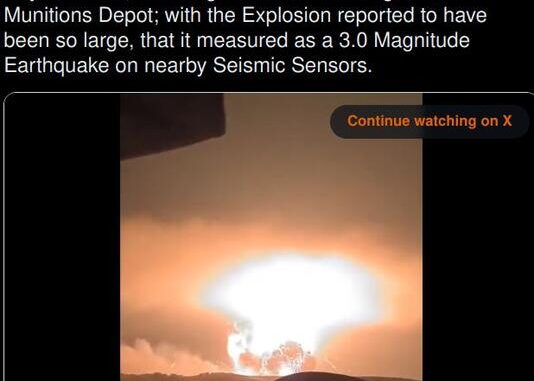
Det skrives i denne artikel fra Vlad
Taget herfra
The tale of the tape:
[TrumfEs: her er en twittervideo , som jeg ikke kan embedde ? klik på linket i stedet]
https://twitter.com/i/status/1868424622946881903
[ TrumfEs : Nå, nu lykkede det med en anden adresse]
So I asked Chat GPT what size bomb is required to create a 3.0 magnitude on the Richter scale:
What size bomb would be required to create a 3.0 on the richter scale
ChatGPT said:
ChatGPT
The size of a bomb required to create a 3.0 magnitude event on the Richter scale depends on several factors, including the bomb’s energy yield, how it’s detonated, and the geology of the area. Here’s a general idea:
Energy Equivalent
A 3.0 earthquake releases approximately 2 gigajoules (2 billion joules) of energy. This is roughly equivalent to:
- 500 tons of TNT or
- A small tactical nuclear bomb (0.5 kiloton yield).
Factors Influencing the Effect:
- Type of Explosion: Underground explosions are much more efficient at generating seismic waves than above-ground detonations.
- Depth: Shallow explosions generally cause higher seismic readings.
- Geology: Softer ground will absorb more energy and reduce seismic effects, while harder rock transmits energy more efficiently.
Historical Comparison
- The largest non-nuclear bomb ever detonated, Russia’s FOAB (Father of All Bombs), has a yield equivalent to ~44 tons of TNT, which would not reach a 3.0 magnitude.
- A 3.0 magnitude seismic event is more in line with a small nuclear explosion, such as early nuclear tests like the Trinity Test in 1945 (~20 kilotons), which registered as high as 5.0 magnitude on seismic readings.
Maybe there is some subtle linguistic distinction between local seismic detectors and the Richter scale. But if they are the same thing, then the answer above is very interesting, no matter how you interpret it.
Even so, if Chat GPT is correct and the largest ever non-nuclear bomb had a 44MT yield, then 500 MT has got to have meaning beyond the usual.
UPDATE:
There are reports of a 3.0 magnitude event at a weapons depot in Syria after an Israeli bombing. Is there news or confirmation of that?
ChatGPT said:
ChatGPT
Yes, recent reports confirm that Israeli airstrikes on Syrian military sites have resulted in explosions registering as a 3.0 magnitude earthquake. These strikes, among the most intense in over a decade, targeted munitions depots and military facilities near Tartus and other regions in Syria.
The Israeli Defense Forces conducted these operations to prevent advanced weaponry from falling into extremist hands, especially following the recent fall of President Assad’s regime. The airstrikes have drawn international condemnation from countries like Iran and Qatar, citing violations of Syrian sovereignty.
In addition to airstrikes, there are reports of Israeli ground operations, with tanks reportedly advancing close to Damascus. Israeli officials justify these actions as necessary measures to secure their borders and ensure regional stability.
For a visual perspective, here’s a video capturing the moment of the Israeli airstrike in Syria:
Taget herfra
Jeg forstår ikke rigtig argumentationen ovenfor?
Han spørger, hvor stor en bombe skal være for at generere et 3,0 jordskælv
Men det er da fuldkommen ligegyldigt ?
Hvis målet indeholdet rigtigt meget sprængstof, kan en krysantimum bombe vel antænde det mål og generere et jordskælv på 3.0 ?
Denne eksplosion er fra 4 august 2020 i Beirut og skete fordi en ildebrand antændte et kæmpe hezbollah-lager 2750 tons gødningsammunition(ammonium nitrat):
Der skulle heller ikke meget til ,og det ser da ud til at den eksplosion var større ?
Kræver vel, at al ammunitionen i depotet detonerer på en gang?
Hvorfor den larmende og idiotiske støj gennem hele første video?