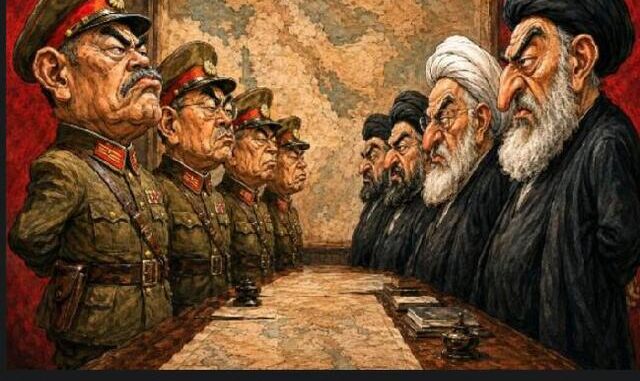
“As President Donald Trump announced, as of August 18, peace talks with Iran had terminated, it will be interesting to see if he pursues a necessary tact markedly different from how Japan surrendered at the end of World War II”
Det skriver James Zumwalt her i en interessant sammenligning
Taget herfra
s President Donald Trump announced, as of August 18, peace talks with Iran had terminated, it will be interesting to see if he pursues a necessary tact markedly different from how Japan surrendered at the end of World War II.
After the U.S. dropped two atomic bombs on Japan, as far as its Emperor Hirohito was concerned, it was the final nail in the coffin of reality. It was he, and not the military, that sought an end to the war. Although his military pleaded with the emperor to fight on to the last man, he understood the high price of doing so. Despite the military’s “never surrender” mindset, its loyalty to the emperor took priority.
Representing the Allies and understanding the Japanese military’s lack of contrition was General Douglas MacArthur. Accordingly, he orchestrated a signing of the surrender documents that would convey the reality of what he could not be commanded.
On September 2, 1945, the Japanese delegation arrived—consisting of only eleven members, most of whom were senior military. The site MacArthur selected was the battleship USS Missouri as it represented the home state of President Harry Truman.The battleship, filled to the brim with overjoyed sailors who had to contain their excitement as per MacArthur’s orders, was joined by 250 Allied ships laying at anchor in Tokyo Bay.
Standing directly behind MacArthur were U.S. General Jonathan Wainwright and British Lieutenant General Arthus Percival. These two men, looking emaciated and much older than they actually were, had both been captured in early 1942—surrendering Corregidor and Singapore respectively at a time the Japanese army appeared to be unbeatable—and spent over three years as prisoners-of-war.
Only a small table stood between MacArthur and the Japanese generals whom he had purposely positioned so the surrendering generals would have to meet the gaze of Wainwright and Percival in a reversed role—the latter now being the victors. When the signing of the document was completed, a thunderous roar was heard overhead as the Tokyo skies were filled with over 450 U.S. carrier planes flying in formation, followed by a fleet of U.S. bombers.
While the Japanese resisted showing a broken spirit, witnesses said tears could be seen in the eyes of some delegation members. MacArthur had achieved his purpose in breaking the Japanese military’s fighting spirit, recognizing, “You do not need a man to kneel if you have already built the room that makes him small.”
But absent Japan’s civilian leadership, it was evident an Allied invasion of the country would have been necessary to bring an end to the war due to its military’s commitment to continue.
Turning to Iran, it is interesting to see the contrast.
Tehran is headed by an emperor equivalent known as the Supreme Leader, ruling along with his mullah associates. Currently, Majtoba Khamenei is the Supreme Leader, elevated to that position following the premature death of his father in an Israeli bombing attack.
When the mullahs first came to power in 1979, as the existing army was loyal to the deposed Shah of Iran, a parallel army consisting of mullah loyalists—the Islamic Republican Guard Corps (IRGC)—was established. The regular army basically operates as an ICE force while the IRGC has a constitutional mandate to ensure the Islamic Republic’s integrity. Ever since then, the IRGC has been the primary force to do the mullahs’ bidding for them.
Although efforts have been made with the mullahs to reach an end to hostilities, it is difficult to achieve such a resolution when the status of Iran’s current leadership is uncertain. Supreme Leader Khamenei may no longer even be alive as he has remained out of public view. A 15-second undated video of him was recently released but, absent a verifiable date, we really do not know if he is still alive.
However, regardless of Khamenei’s current status and despite the devastation the U.S. has wrought upon Iran, it should be obvious the mullahs lack any desire to surrender. Theirs is a mindset mandating that all other religions submit to Islam—a mindset that will forever leave them committed to fighting a war that has been fought for 1,400 years now. And they, like the Japanese generals, prefer to see the country fight to the last man rather than surrender. Unfortunately, what worked to end World War II is not working to end the Iran war.
This is why President Donald Trump embarked upon a new diplomatic direction in hopes of securing peace. And, unlike the Truman administration which pursued it through civilian authority, it appears Trump has re-directed efforts to pursue it through military authority—i.e., the IRGC—by opening a direct backchannel link.
Obviously, it is through the IRGC that the mullahs live and breathe. And, while the surviving mullahs can turn a blind eye to the devastation heaped upon the country, for the most part it is the IRGC that has borne firsthand witness to the devastation that has occurred. While the IRGC may huff, it is too exhausted to do much puffing. Just like Hirohito grasped the reality about the war, so too does the IRGC as it embraces a reality that is undoubtedly breaking its fighting spirit.
Despite the Islamic extremism that feeds both the mullahs and the IRGC, it is those who really know the face of war, rather than just the sound of its guns, who are more likely to engage in a serious effort to end it.
Taget herfra
Jeg fatter ikke denne pausediplomati. De skulle have massakreret det styre, imens de var igang. Nu kan vi følge klovnediplomatiet.
Fuldstændig rigtigt. Nu truer Trump igen med al landens ulykker, og bål og brand, og bombninger af lortet ud af og osv osv. Denne gang er det Oman der skulle have følere ud til Iran…